
TELEMEDICINE
Overview
Chunghwa Telecom Laboratories leverages advanced technologies—including mobile communications, the Internet of Things (IoT), artificial intelligence (AI), cybersecurity, and healthcare ICT—to develop innovative solutions such as a Remote Patient Monitoring System, a Telemedicine Platform, and an Emergency Medical Response Solution. These initiatives support the government in improving access to healthcare in rural and underserved areas and advancing healthcare equity. The Remote Patient Monitoring System extends professional medical care into homes and communities, helping to reduce the burden on both patients and hospitals. The Telemedicine Platform enables remote consultations and outpatient services, making it easier for residents in areas with limited medical resources, as well as individuals with mobility challenges, to receive timely and appropriate care. In addition, the Emergency Medical Response Solution facilitates the efficient allocation and coordination of medical and rescue resources, strengthening the resilience of emergency healthcare services and safeguarding the lives and health of the public.TELEMEDICINE
CORE TECHNOLOGY
- AIoMT(Artificial Intelligence of Medical Things)‑based physiological monitoring integration and automatic synchronization technology
- Multi‑source audio‑visual collaboration and AI‑assisted documentation technology
- Medical information interoperability and system integration technology
- Electronic prescription exchange and online payment integration technology
- Emergency information exchange technology
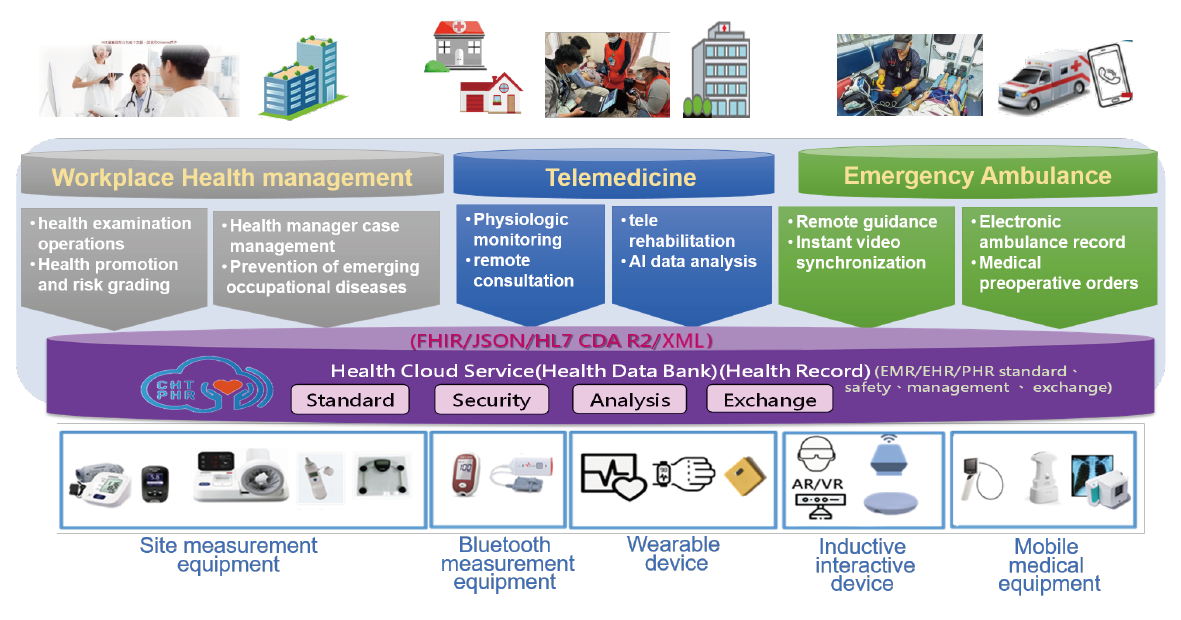
Smart healthcare diagram
TELEMEDICINE
APPLICATION SITUATION
Remote Patient Monitoring System: This system integrates physiological monitoring and automatic data synchronization based on AIoMT. It connects to various mobile medical devices, including blood pressure monitors, pulse oximeters, thermometers, vital signs monitors, portable X-ray machines, and biochemical/blood analyzers. It supports automatic uploading of measurement data for continuous tracking by the medical team. Simultaneously, AI can aggregate and analyze multi-source data, issuing alerts for sepsis and other clinical deteriorations to help clinicians take timely action. It also supports video consultations and patient education through multi-source A/V collaboration and AI-assisted recording, enabling professional guidance and coordinated care with families. It helps mitigate overcrowding in emergency and inpatient departments and improves patient safety. Currently, it has been adopted by more than 70 medical institutions in over 20 counties and cities, covering all levels from home care stations and clinics to large medical centers. It supports multiple care models, such as Hospital-at-Home (HaH), emergency room transitional care, institutional care, and hospice care, and won the 2026 Taiwan Excellence Award.
Telemedicine Platform: This platform seamlessly connects mobile medical devices with hospital information systems. By combining interactive video technology with AI-assisted recording, it provides remote video consultations, smart summaries of medical records, and health education. It improves healthcare accessibility by reducing travel time. It also helps prevent the spread of nosocomial infections by avoiding crowded waiting rooms and buys crucial pre-hospital treatment time for emergency and critical care patients. Ultimately, this addresses healthcare resource disparities, promotes health equity, and makes medical care more accessible to everyone. The platform supports rural healthcare facilities (such as Dulan Clinic, Chishang Hao Clinic, and the Alishan Township Public Health Center) as well as major regional hospitals and medical centers (such as Show Chwan Memorial Hospital, Fu Jen Catholic University Hospital, and National Cheng Kung University Hospital…) in setting up remote outpatient clinics and joint consultations. Furthermore, by integrating electronic prescriptions and online payments, it completes the "last mile" of telemedicine—eliminating the need for patients to travel to and from facilities for billing or medication collection.
Emergency Medical Response solution: This solution leverages multi-source audio and video collaboration, AI-assisted documentation, and integrated emergency information exchange technologies to strengthen emergency medical services. Key features include remote consultations, automatic summarization of emergency care records, medical equipment and medication management, pre-hospital alerts, and real-time emergency department capacity management. The solution has been successfully implemented in Kaohsiung, connecting central government agencies, hospitals, and fire departments. Through cross-agency data exchange and real-time information sharing, it enables coordinated dispatch and efficient allocation of emergency medical resources—enhancing response speed and effectiveness during disasters and large-scale incidents. The solution also supports maritime emergency medical services in collaboration with the Coast Guard Administration. It provides remote medical consultations at sea, synchronizes rescue data between command centers and vessels, and facilitates integrated resource management. These capabilities strengthen offshore emergency response capacity and improve overall rescue performance.