

OTT Video
Overview
As the wave of technological innovation continues to accelerate, traditional live broadcasting services are increasingly unable to meet the evolving expectations of modern audiences. The industry is therefore moving toward low-latency, 4K ultra-high-definition, free-viewpoint, and intelligent recommendation–driven streaming services. According to Grand View Research, the global live streaming market is projected to reach approximately USD 345.1 billion by 2030, highlighting the sustained growth in demand for real-time audiovisual services.The audiovisual service solution developed by our institute integrates 5G broadband networks with a low-latency OTT transmission architecture, enabling remote viewers to access next-generation, diversified content on mobile devices with minimal delay. This approach delivers real-time interaction and an immersive viewing experience. In addition, an AI-based audiovisual quality monitoring system has been implemented to detect video and audio anomalies in real time, ensuring broadcast stability and service reliability. An intelligent audiovisual experience technology has been developed, leveraging AI to analyze user viewing behavior and content features in order to optimize personalized recommendation processes, thereby enhancing content reach and strengthening user engagement. Through these R&D achievements, a comprehensive audiovisual technology framework has been established, encompassing low-latency transmission, intelligent quality monitoring, and AI-powered content recommendation. This integrated system continues to drive innovation in next-generation streaming services.
OTT Video
CORE TECHNOLOGY
- Low-Latency OTT Streaming Technology
- Free-View Video Technology
- Smart Audiovisual Experience Technology
OTT Video
OTT Video
Application Status
Low-Latency OTT Streaming Technology: This technology optimizes the live streaming transmission architecture to enhance low-latency performance and service stability. It will soon introduce an AI-based audiovisual quality inspection mechanism to automatically detect video and audio defects and anomalies, thereby strengthening real-time monitoring capabilities and improving operational management efficiency. The related outcomes have been deployed on the company’s HamiVideo live broadcasting platform (including sports events and large-scale event streaming), effectively enhancing service quality, user viewing experience, and overall system stability. These achievements establish a critical technological foundation for the company’s low-latency OTT services.
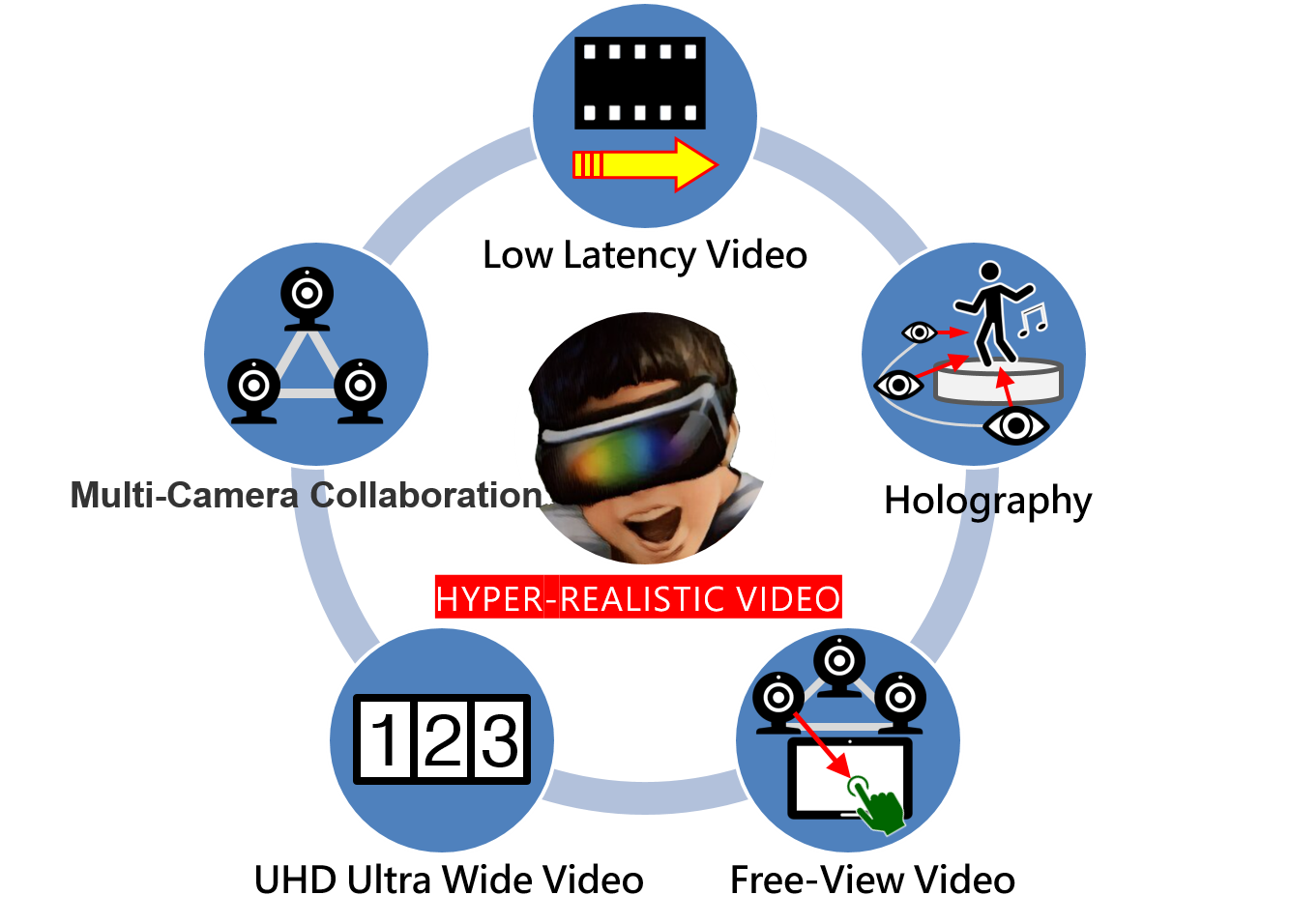
Free-View Video Technology: Multiple cameras are set up in a ring to shoot the same target. Users can watch freely switch the video angle they want to watch (such as the bullet time of the movie “The Matrix”) through mobile devices, personal computers, and web browsers to provide a personalized viewing experience. By leveraging the high bandwidth and low-latency characteristics of 5G and MEC edge computing, the system enables on-site audiences to use their own mobile devices to synchronously view multi-angle, high-definition live video with imperceptible delay. Through AI-based video frame interpolation technology, a virtual viewpoint image can be rapidly generated between two physical cameras to expand video content. The research and development results were presented at the 2023 National Theater and Concert Hall 5G Technology Application Workshop and the 2025 AI WAVE SHOW. The technology can be applied to a variety of performance activities, such as sports events, dance performances, fitness coaching, and related scenarios.
Smart Video Experience Technology: Smart Video Experience Technology leverages artificial intelligence and video data analytics to integrate content understanding, user behavior analysis, and generative AI capabilities, delivering a more intelligent and personalized streaming experience. The system establishes a multi-layered video tagging framework and a video knowledge graph that integrates content attributes such as genre, themes, characters, cast, and storyline elements to form a comprehensive “content DNA” for each title. By combining this content intelligence with users’ viewing histories and overall audience trends, the system enables precise personalized recommendation mechanisms. For video content understanding, AI-powered subtitle analysis is applied to analyze subtitle text and semantics, automatically extracting themes, plot elements, and key features to enrich existing metadata while improving the quality of video tags and the accuracy of content search. In addition, a generative AI conversational assistant is introduced to help users quickly discover content that matches their preferences through natural language interaction, enhancing content discovery efficiency and enabling streaming services to better align with viewers’ interests and needs.
A total of 16 patents have been applied for and certified by 2025.